Assisted Stretching in Frederick

Are you looking for a clinic that will provide assisted stretching?

Park Bench Chiropractic is primarily a chiropractic office. We have two full-time chiropractors, long-time Frederick residents, who have been practicing right here for nearly two decades. While nearly all of our patients receive chiropractic adjustments during their office visits, many of them only come for stretching.

As chiropractors, we are licensed to diagnose and treat a wide variety of musculoskeletal conditions, including but not limited to:

-sciatica

-spine pain

-joint pain

-shoulder and hip pain

-neck and shoulder pain

-tension headaches

-and much more.

Both Rob Romano DC and Dr. Matt Schooley DC are licensed in Maryland to utilize physical therapy modalities, including muscle stimulation/TENS, massage, trigger point therapy, myofascial stretch therapy, and a variety of chiropractic techniques.

Our education and experience means that instead of just showing up somewhere and getting stretched, you will get examined and diagnosed to rule out potential complicating issues. Stretching can be dangerous for certain people with certain conditions. Just ask any over-eager dad who jumps into yoga because it looks easy and his wife does it all the time.

Another benefit of choosing Park Bench for your assisted stretching is that we accept many major insurance companies. That means if you have UnitedHealthCare, BCBS, Aetna or certain other insurances that we can bill your insurance and you may just have to pay a copay instead of paying for a more expensive session elsewhere. As licensed healthcare professionals we have received training specifically in stretching techniques.

We have been stretching clients for a long time, but assisted stretching was never really a big thing until the past year or so. Now that assisted stretching is a thing, we want to make sure that people understand that we also offer this service.

To summarize, we can offer assisted stretching to our clients, we can potentially come in a much lower price point due to being able to bill your health insurance, and we have knowledge and experience that allows us to manage your condition effectively, rather than just stretching you and hoping things work out for you.

While many people really do just have “tight muscles”, quite often that tightness is due to an injury or postural problem. By seeing a chiropractor you can find the root of the issue, get a good stretch, get some additional home exercises, and get a chiropractic adjustment (if you want) as the cherry on top.

Call us to ask about stretching.

Sleeping Bags, Pull-Out Couches, and Futons

With Summer comes the annual Summer vacation. Depending on your family size and budget, these seasonal trips often involve some improvisational sleeping arrangements.

After a 12-hour drive halfway across the country, complete with a stop at Buc-ees, you arrive at some dark hour at your destination, or a hotel along the way.

Sleepy Mom Waking Up Exhausted

If you had the opportunity to sleep – or maybe just try to sleep – in a bed that isn’t comfortable, then you know the feeling of waking up and feeling even worse than when you laid down in the first place.

Sometimes you can shake it off or walk it off in a few hours, or maybe a day or two. Sometimes the pain and the stiffness just refuses to let go of your body. No matter how many stretches you did, or how much resting you engaged in, your back still felt like trash.

If that’s you, then give us a call @ (301) 378-0334.

Opioids and Chiropractic

According to research published in the Journal Pain Management, titled “Impact of Chiropractic Care on Use of Prescription Opioids in Patients with Spinal Pain”, concluded that:

Conclusions: Patients with spinal pain who saw a chiropractor had half the risk of filling an opioid prescription. Among those who saw a chiropractor within 30 days of diagnosis, the reduction in risk was greater as compared with those with their first visit after the acute phase.

In other words, if the person STARTS their care with a trip to the chiropractor (preferably also with seeing other healthcare providers, too), then that person is half as likely to even bother filling their opioid prescription. Presumably, that person felt less pain and was less likely to need addictive prescription opioids. That research was published in 2020.

Newer research, published in 2025, confirmed this relationship with chiropractic care lessening opioid use. University Health in Cleveland found that:

…an association between spinal manipulative therapy and a lower risk of opioid use disorder in this population, highlighting its potential value as a first-line non-pharmacological option for low back pain amid the ongoing opioid crisis.

So, research is consistently showing a decrease in opioid use when chiropractic care is a first-line treatment for people suffering from lower back pain. These results probably also will show the same opioid decrease with neck or shoulder or hip pain, and most other musculoskeletal pains. Body parts may all be different, but the way the body manages pain is pretty much the same no matter if it’s the knees or the elbows.

This research shows that chiropractic can help someone AVOID even needing opioids. That’s great. But, what if you already are using opioids? Chiropractors cannot prescribe or manage any medications, that is entirely out of our “scope of practice”.

Many injuries, like whiplash or neck strains, low back disc bulges, chronic knee or shoulder pain, and even migraines can be successfully treated with chiropractic care.

If you are currently suffering from muscle or joint pain and you are using opioids to manage that pain, consider talking to your primary care provider or your VA healthcare doctor – or whoever helps you with your health – and telling them that you are going to try chiropractic.

If you’re freaked out about going to a chiropractor, that’s okay. That’s not an uncommon thing for people to tell us. A lifetime of damage to your body and brain from opioids, though, is truly a much bigger thing to be worried about. Your liver, your kidneys, your stomach lining, your neurotransmitters…a lot of things inside your body undergo negative changes with extended opioid use. If going to a chiropractor every few weeks and spending a copay or $60 gets you to a place where you are taking less pain medication, that is a real long-term win for your body and brain.

If you’re interested in trying chiropractic and if you are in Frederick, give us a call. You can set up a new patient appointment or ask about a free consultation where you can just come in with questions.

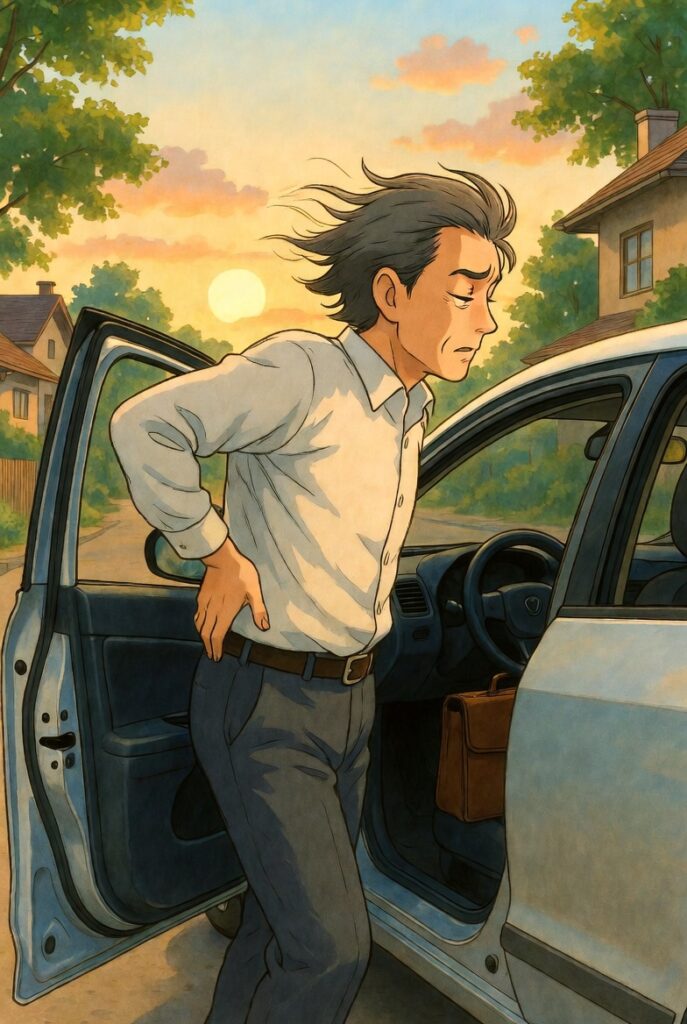
Pain Getting In and Out of Car

If you’re like many other people here in Frederick, you make the trek South on 270 towards DC/Rockville/Northern Virginia, or East on 70 towards Baltimore up to 5 days each week. That can be easily more than an hour commute in the morning and then another hour in the afternoon.

If you live in Frederick and travel to Northern Virginia five days per week, that’s about 45 miles each way, and an hour or so each way. Unless you’ve somehow achieved the “perfect driving posture“, you will want to keep reading.

That’s 90 miles/day and 2 hours in the car. If you sleep for 8 hours and eat for one hour each day, then work for 8 hours, that leaves you with 5 hours to actually have a life each day after accounting for your commute. Most of those 5 hours is cooking, cleaning, shopping/errands, and perhaps some relaxing (if you don’t have kids).

That’s 450 miles/week and 10 hours in the car.

That’s 1,800 miles/month and 40 hours in the car.

That’s 21,600 miles/year and 480 hours in the car.

For some added perspective, the amount of time in your commute each year is equal to 12 weeks of full-time work, or 12 one-week vacations. For a typical full-time worker with that commute, you are spending one entire workweek of time in the car commuting every single month. Your commute tacks on a 25% time tax to your actual workday.

We can all agree that too much time in the car, especially in stressful traffic is not a good thing for the spirit.

The best we can do, in that case, is to try to make sure we are using good posture during those 40 hours per month and 480 hours per year.

So, let’s review some basics of driving posture.

Prevent “Text Neck”: If you catch your chin jutting forward—especially in heavy traffic when concentrating or just getting angry—gently pull your chin straight back and press your head into the headrest. It’s like trying to make a double chin. Do a set of 10 presses back into the headrest and then keep your head there.

Avoid the “One-Armed Lean”: Resting one elbow on the center console tilts your spine and rotates your shoulders. Keep your weight symmetrical. Don’t just lean on the window/door, either. Mix it up a bit.

Relax Your Shoulders: Set the steering column low enough so you do not have to lift your arms above shoulder level, which causes upper back and neck strain. Actually think about whether or not your shoulders are up or down. In fact, let them drop If they drop, they were being held up by your muscles.

Use the Dead Pedal: Utilize the vehicle’s angled footrest (dead pedal) to support your left leg and keep your pelvis squarely aligned, rather than letting your legs splay outward. The more symmetry you can get with your posture, the less likely the hips will be hurting.

There are a lot of ways we can each improve our commute. Let’s be honest, no one is perfect. No one has perfect posture. No one has a perfect commute.

If you have to climb out of the car as you pull into the driveway or into your office, and your first ten steps are “limpy” and painful, then perhaps you should drop by our office or give us a call. Not only can we assess your driving posture and offer some cues and advice on how to improve your commute, we can treat the hips and shoulders and neck and get some of that tension and pain taken care of.

If you’ve never been to a chiropractor before, consider making us your first! If you’re really not sure, ask around and find one of our thousands of local Frederick patients and ask them about their experience.

Inguinal Hernia and Hip Pain

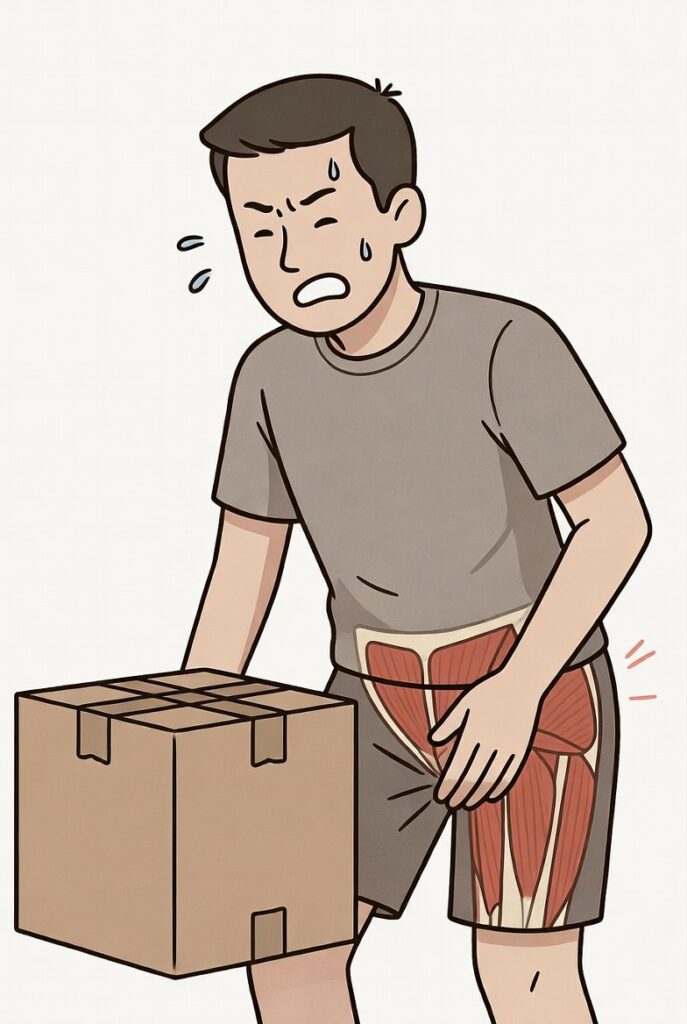
People can develop a hernia in their groin area, near the crease of the hip. This can feel like a fullness, a pulling pain, or a deep ache. This pain or sensation can be in the groin, into the upper thigh, of the testicles or “privates”. This is often a result of a lifting injury. Sometimes, though, these are present at birth (“congenital”) due to a weak spot in the abdominal wall. Other causes can include coughing or sneezing, prior surgeries in the abdominal area, obesity, pregnancy, or heavy exercise.

Looks like the Frederick UPS guy should be using both hands and lifting more carefully!

The term hernia means something has “herniated” through an opening that shouldn’t be there. Inguinal hernias can have intestines poking through. Other times it can be fatty tissue.

Some types of lower back or hip injuries can cause pain that mimics inguinal hernia pain. These can be differentiated with a simple exam in most cases. Recognizing the differences between inguinal hernias and hip or spine pain allows the person to engage in healthy stretches or exercises to help reduce the pain, while not being aware of which condition you have might cause you to engage in lower back or core strengthening exercises that will worsen the hernia and cause more pain. The person with a hernia may keep doing core exercises to address the hip pain they feel, but the pain will worsen with the exercising, and so they will do even more core exercises to help get that stability they are chasing, when in actuality they are worsening their problem.

If you think this might describe something you are going through, give us a call at (301) 378-0334 and schedule a new patient appointment.

It Looks Painful

I am hit with this question a lot from new patients: “Does it hurt? It looks like it hurts!”

My answer is always something like, “No. It usually feels great. But, sometimes it can hurt a little bit.”

If it’s going to hurt, it’s almost always because the area being adjusted is already hurting. Think about it this way: If you are going to the chiropractor because your hip hurts, if every time you bump into something with your hip you feel a bruised and sore feeling, and if every time you bend over at the hips you feel hip pain, then it certainly makes sense that when a chiropractor is adjusting (or even simply touching) your hip that you might experience some discomfort, however short-lived.

Have you ever stretched out a cramping and sore muscle? It might have been relieving but also it was probably sore.

Have you ever worked out hard at the the gym and you’re sore for a few days? Exercising was certainly a good thing, but sometimes even good things hurt for a bit.

Just because something causes discomfort in the moment doesn’t mean you’ve been hurt.

If a joint in your neck is locked up, injured and inflamed, then it’s already hurt. A lot of new patients come in with something just like that –> a sore area of the spine that isn’t moving right. They can’t look to the right, for example.

The way to get normal movement restored, and to get rid of the pain, is to work right at the sore area. That means treating the overlying muscles and getting them to relax enough to allow for a successful adjustment. Then it means putting enough force into the joint to get the (synovial) capsule to “pop” as full motion is restored. That pop and then relaxation of the spinal muscles around the joint are the things that help push that spinal joint towards normal, healthy function. Once that joint can move freely for a day or three the inflammation and pain will be decreased and the person feels better. They look left and right and up and down with no issues and the problem gets forgotten.

Now, I do admit that getting the joint to move normally requires a degree of coaxing. I can’t just ask the joint to move normally, I need to make it do that. That means I need to use force, and I need to do that in an area that is already sore. And I need to apply that force at the proper angle, with the right amount of pressure, and in a safe manner. The neck is full of important stuff!

Will it hurt? Maybe, for a moment. I’ll be honest, sometimes the person will be sore for a day or so, until the body works through it. Drinking a lot of water and applying some ice is warranted, for a powerful correction to the spine. Many people are never sore from adjusting, during or after. It’s not always easy to predict who will be sore, so we tell most new patient to expect some soreness for a day or two after their first adjustment. If you haven’t ever been adjusted, or it’s been years, then the first adjustment can certainly leave you a bit sore.

One last thing to note – being sore isn’t necessarily a bad thing.

Of course no one wants to feel bad. But if a stuck spinal joint has been inflamed and sore for week or months, then it’s quite likely that the adjustment will create some soreness because a stuck and neglected joint is finally moving for the first time in a long time. I’ve had patients that took a few adjustment to get relief, and each time we got some movement in the spine, but not enough. Then, when a well-placed and right-on-time adjustment really hits the spot, the amount of joint capsule stretch and muscle release that happens can be uncomfortable in the short-term. The day or two of soreness from a good adjustment is way better than continuing with week-after-week or low-level neck pain that keeps you from enjoying life.

Hiking and Biking Pain

Now that the weather is getting warmer and the sun is setting later in the day, the opportunities for getting physical activity outside are all around us. Baker Park is beautiful and a walk around Baker Park and Culler Lake is about 2.5 miles and approximately 58 acres of greenery, pools, and playgrounds. If you live downtown then you have no excuse not to enjoy a walk around town or the park for some good exercise. Walk around downtown and grab a coffee or tea and do window-shopping.

Walking is a fundamental human motion. It’s one of the first things we learn to do as humans and it is one of the most depressing abilities to lose as we get older. Go talk to a wheelchair-bound person and see how depressed they are being unable to move around on their own, without someone else’s help.

Our bodies being functional and working is a necessary requirement for maintaining our independence and our happiness. Sometimes we do not really take into consideration that our ability to do something as simple as walking can be taken away from us. Now, I’m not trying to be scary or anything, but it is not unusual for a new patient to come into the office barely able to walk. They will be dragging a leg, or limping, or really just barely even standing up straight at all.

So get out there and get some walking in, maybe do some running, or get on a bike and pedal around a bit. Motion is lotion! The more we move, the more we can move.

If you are already living a healthy and active lifestyle, that’s awesome. If you hit some speed bumps with hip pain or shoulder pain, give us a call and come in and see what we can do to help you function at an even higher level. If you aren’t in the best shape of your life and you know you need to step up your activity level, then you should expect some injuries and some discomfort on the way back to being fit, and we would love to help you navigate that journey.

So, get out there and enjoy the improving weather. When you need a tune-up, call Park Bench and get in here so we can work out the kinks.

Call today @ (301) 378-0334.

Hip and Shoulder Pain with Gardening

Sometimes you’re down there on the ground, digging in the dirt, pulling weeds…just sweating it out and working the garden. You go to stand up and BAM! Suddenly your hips and butt are hurting, you’re limping back inside to grab a cold, refreshing drink, and you feel like your leg may just be tingling and dragging a bit.

There are plenty of things that can go wrong with a knee, a hip, your back, your shoulder, or any other body part when you’re getting into the garden. Come on and and we will figure it out and make some suggestions about how to feel better quick and hopefully never have it happen again.

Sometimes it is your piriformis muscle. That’s one of the butt muscles. Sometimes it’s the lats, the traps, the gluts, the hammies or the psoas. It can be a muscle or it can be a joint. Sometimes it’s the rib joints, the lower lumbar discs, or even the shoulder joint. Gardening is tougher than it looks. You need to move the dirt, pull the weeds, water the seedlings, and on and on. A good gardener works throughout the season.

Matt and Rob both are avid gardeners. We might even share tips and tricks while we work on you.

Never been to a chiropractor before? Come to us!

Stretching in Frederick

Here’s something you might not know about Park Bench. We do a lot of stretching on our patients. We may be chiropractors, but we really like to make sure the muscular system is working correctly.

Adjusting something and then having tight muscles pull everything back out of whack is a letdown for both the chiropractor and the patient. Sometimes the tight muscles, from posture or injury, are the actual cause of the problem. If we don’t do something about that, the problem comes right back.

Lately, some other businesses have been popping up offering expensive stretch sessions for clients.

We’ve been doing this for more than 15 years. We stretch legs, hips, calves, shoulders, necks, forearms, backs and wrists. Chiropractors in Maryland have licensing options including with or without “Physical Therapy privileges”, and both Dr. Matt and Dr. Rob have those privileges, and one of the main things we like to do with that is to hit tight muscles with a good stretch alongside the adjustment. Many of our clients tell is that it’s one of their favorite things about our practice.

There’s even a decent number of our patients who just want to be stretched during appointments. Definitely not most of the patients, but there are some who just want that, or some other type of mobility work.

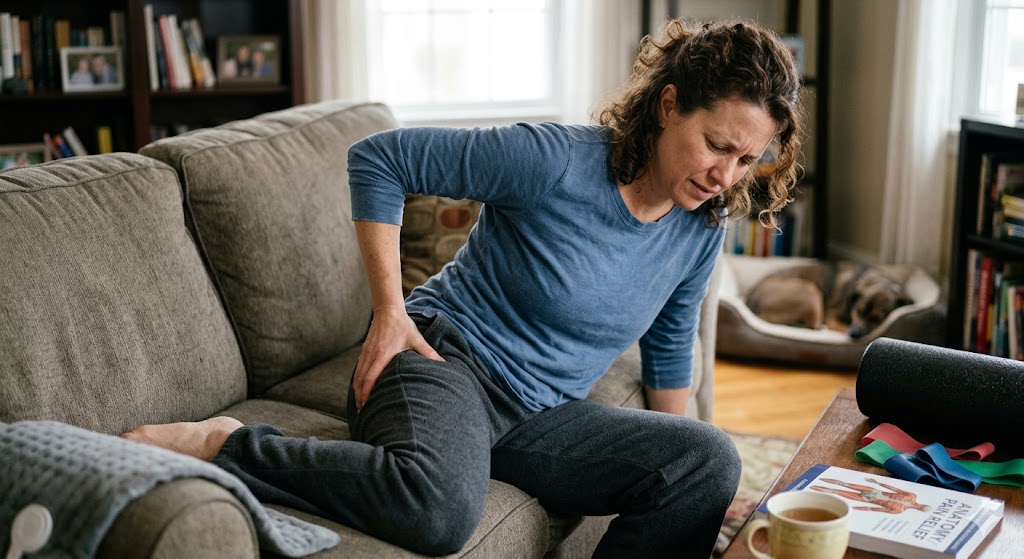
If you’ve had chronic (years!) of lower back pain that causes you pain to get up and down from prolonged sitting, and if your hips are tight, then consider making an appointment and having us check out how tight those muscles are. Sometimes a good adjustment to the SI Joints and lower ribs, coupled with some nice deep stretches of the hips, will lead to almost immediate relief.

Shoulder Mobilization

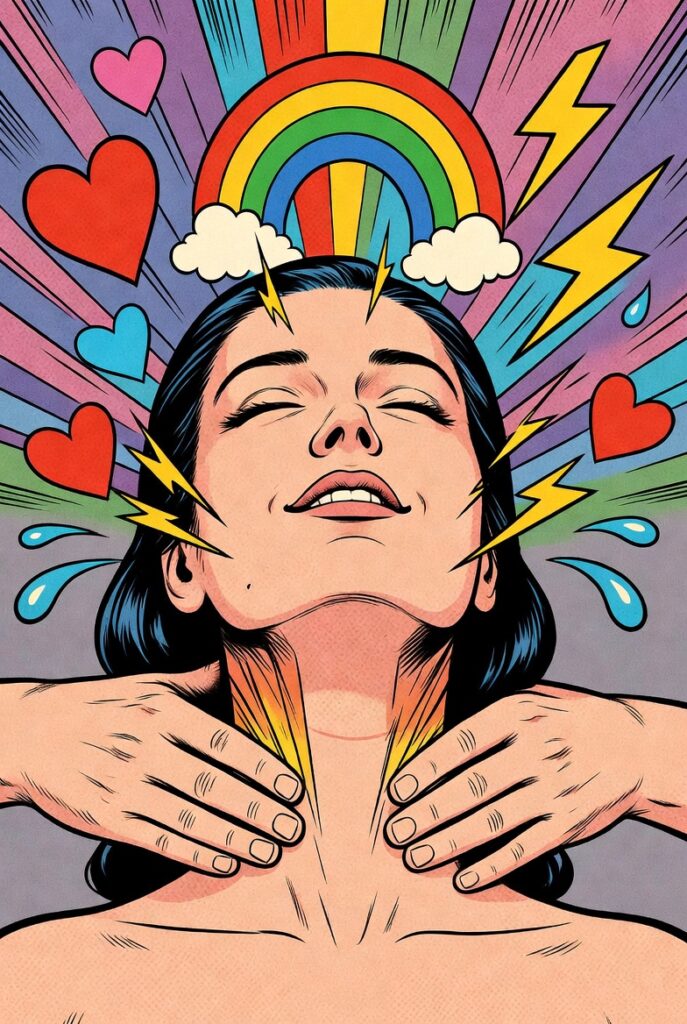
Another great way to get relief is with shoulder mobilization. This means we are using our hands to grab your shoulder blade (scapula) and, with force and pressure, cause it to glide up and down and even pull it off the back to create some space between the shoulder blade and the back ribs. This can feel like a mix of pain and relief that most people don’t particularly enjoy in the moment but are relieved when it’s done and the shoulder blade has more normal movement restored. While we don’t always need to adjust the upper back and neck, this shoulder mobilization goes really well with neck and upper back adjustments.

If you have been in pain, especially if it’s your dominant “computer” hand and your neck, perhaps even with headaches on that same side, then you should think about coming in for some neck and upper back work and some shoulder mobilization. Give us a call and set up an appointment.

YouTube Chiropractors

You’re not going to find Rob or Matt on Youtube doing “Crazy Chiropractic Adjustments“.

It’s not that we’re not super-cool fun guys. We are the coolest. Truly.

CoOleSt YouTUbe ChIroPraCTOr in FredERiCK!!

Do we occasionally get airborne trying to get a stubborn vertebrae to finally unlock? Maybe we do. Sometimes you really need to get some heavy leverage to get the thing to happen!

Do we have a Y-strap in the office? Maybe we do.

Do we advertise it to entice people, who may or may not actually benefit from it, to come get their necks yanked and cranked? No, we do not do that.

When the patient is too much in charge, this is a bad thing. This is Rob here writing this, for those that know me. I have a Y-strap in my office. I place it where no one can see it. I do not want my patients bugging me to use it on them. Some patients I show the strap to and I describe the use of it and I tell them about it, and those are the patients who I think can safely benefit from that type of cervical traction.

The last thing I want is some hyper-mobile 21 year old with headaches from horrible posture coming in and expecting the Y-strap adjustment…because they saw it on the Internet. That person is not an ideal candidate for that modality.

Ironically, that person will probably get the ultimate “CrAcK!” from that adjustment as their head nearly separates from their body and their upper cervical stability ligaments are tested to the max, but those fireworks do not mean anything will be any better. They will feel great for a few hours of adrenaline and endorphins, the next day might be another story altogether.

Will some other chiropractor gladly take their money and apply 50+lbs of mechanical force, pulling their skull away from the neck with a sudden tug? Probably! Not us, though.

You may very well respond favorably to the Y-strap style of cervical traction. A really great part of chiropractic school is that I can tell the difference between someone who probably will benefit from that and someone who has an unfavorable risk profile for the Y-strap.